
The Floor Is Not a Blank Canvas: Why Indian Homes Need a Different Approach to Carpets

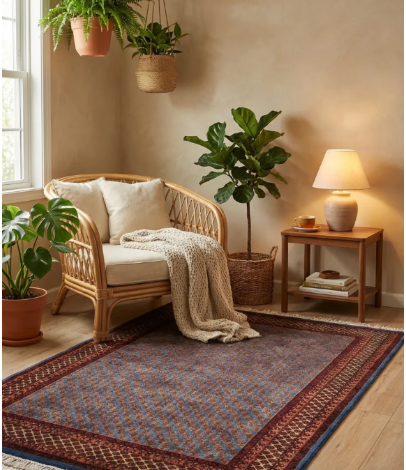
A carpet is rarely chosen in isolation. By the time someone starts looking for one, the sofa may already be ordered, the curtains selected, and the flooring installed. That leaves one important design question: what does the floor already contribute to the room?
In Indian homes, the answer can be quite a lot. Marble veining, glossy vitrified tiles, terrazzo chips, patterned ceramic flooring and stone borders all create their own visual character. Placing a handmade carpet over them without considering those details can make a room feel unnecessarily busy or visually disconnected.
The better approach is to treat the floor, furniture, and carpet as parts of one composition. The carpet should respond to what is already there, not simply fill an empty patch.
Your Existing Flooring Has a Visual Language
Different floor finishes create different starting points for handwoven carpet selection. The distinction is not merely about colour. It is about pattern, texture, reflectivity, and how much attention the floor already attracts.
Marble flooring: Natural veining creates movement across the floor. A heavily patterned Persian carpet can work with it, but the scale and contrast of the two patterns matter. If both have strong, closely spaced details, the room can become visually crowded. A quieter field, restrained border or pattern that picks up a secondary marble tone may work better.
Glossy vitrified tiles: Large-format tiles often create a relatively uniform surface, particularly when grout lines are subtle. This gives a thick carpet more room to introduce pattern, colour or texture. However, a highly reflective floor can make colour and contrast appear different under daylight and artificial lighting. Check the carpet in the actual room rather than judging it against a product photograph.
Terrazzo and mosaic flooring: These surfaces already contain multiple colours, chips or repeated details. A handmade carpet does not necessarily need to repeat that complexity. A solid, tonal or broadly geometric design can provide a visual pause while allowing the flooring to remain visible around it.
Patterned cement and decorative tiles: Here, the floor may already be a design feature. Covering most of it with a dense carpet can remove the very detail that makes the room distinctive. A smaller, simpler carpet can introduce softness without concealing the flooring’s composition.
The useful question is not whether a particular area carpet style suits a particular flooring material. It is whether the two surfaces have enough visual difference to complement each other.
Pattern Should Be Chosen by What the Room Already Contains
Flooring is only one source of visual detail. Upholstery, curtains, cushions, artwork, wooden furniture, and even architectural mouldings contribute to the room’s overall pattern.
Consider a living room with a floral sofa, printed curtains and decorative wall panels. Adding a large carpet with an equally prominent floral or medallion pattern introduces another competing focal point. The problem is not that the patterns are individually unattractive. They are competing for the same visual attention.
A more considered combination could use a textured carpet, a restrained geometric design or a pattern with a lower contrast. Conversely, a room with plain upholstery, simple walls and uncomplicated flooring has more room for a bold abstract or traditional carpet.
There is also no need to match every colour exactly. A handmade carpet can connect two elements through a secondary shade. For instance, a muted rust detail in the carpet might pick up the wood finish or a cushion accent without repeating the sofa’s entire colour.
A practical way to judge pattern: Step back and look at the room from its entrance. If the carpet, upholstery and floor all demand attention immediately, one of them may need to become quieter.
The Carpet Must Fit the Furniture Arrangement, Not Just the Room
A designer carpet can have the right colour and pattern and still look misplaced because its dimensions do not relate to the furniture.
The relevant measurement is not simply the length and width of the room. It is the footprint of the arrangement the carpet is meant to define.
In a living room, the front legs of a sofa and accompanying chairs can sit on the carpet to visually connect the seating group. A small carpet placed only beneath the coffee table may leave the larger furniture arrangement looking disconnected.
In a bedroom, the carpet’s position should relate to where people step out of bed. A narrow decorative piece placed far from that movement may look attractive but offer little practical value.
Dining spaces require a different calculation. Chairs move backwards every time someone sits down or gets up. The carpet needs enough room to accommodate that movement, not merely the footprint of the dining table when nobody is using it.
This is especially relevant in homes where the living and dining areas share one open space. A carpet can help define the seating zone, but its placement should not interrupt the route between the dining table, kitchen, balcony, or main passage.
Before purchasing, mark the proposed dimensions on the floor with masking tape. Move the dining chairs, open nearby doors, and walk through the room. This reveals problems that a product photograph cannot show.
A Carpet Should Not Automatically Cover the Best Part of the Floor
One common design assumption is that more floor coverage makes a room look more complete. That is not always true.
A home with a distinctive marble border, decorative stone inlay, or carefully selected patterned tiles may benefit from leaving more of the floor exposed. In some interiors, the flooring itself has been designed to create a carpet-like composition. Covering it with a textile carpet can obscure that architectural detail.
The opposite can also be true. A plain, hard floor may feel visually unfinished or lack the softness needed around a seating arrangement. In that situation, a larger carpet can give the furniture a clearer visual base.
The decision should depend on what the floor contributes and what the room lacks. Do not buy a large carpet simply because the room is large. Equally, do not choose a small one merely to preserve an arbitrary amount of visible flooring.
Material and Pile Height Matter Beyond Appearance
A handmade carpet also changes how a floor feels and functions.
A thick, high-pile carpet can feel comfortable beside a bed or in a relaxed seating area. However, it may be inconvenient near doors, under frequently moved chairs, or along narrow circulation routes.
Flatweaves and low-pile constructions can be more practical in areas where furniture moves regularly. They also allow more of the flooring to remain visually present.
Material selection should follow the room’s use. Wool, cotton, jute, and silk or viscose blends have different textures and care requirements. A dining area exposed to food spills needs a different maintenance considerations from a bedroom where the carpet is primarily used underfoot.
The important point is to assess construction alongside design. A carpet that looks right but creates daily inconvenience is not the right choice for that room.
Three Checks Before You Buy a Carpet
Before finalising a design, assess these details together:
- Floor: Identify its dominant colour, pattern, finish, and visual intensity. Look at it in daylight as well as at night.
- Furniture: Consider upholstery patterns, wood tones, furniture dimensions, and the area the carpet needs to anchor.
- Movement: Check door clearance, chair movement, walking routes, and whether the carpet needs an appropriate anti-slip underlay for the floor surface.
Do not judge a carpet sample against a white background alone. Place it directly on the flooring and view it beside the sofa or furniture fabric. The same shade can appear quite different when surrounded by marble, warm wood, or glossy tiles.
Choose the Carpet After Reading the Room
The best handmade carpet choice is not necessarily the boldest pattern, the largest size or the most expensive construction. It is the one that makes sense alongside the flooring, furniture, and everyday use of the space.
A room with patterned flooring may need restraint. A plain floor may benefit from a stronger design. A carefully detailed stone surface may need to remain visible, while a simple living room may need a larger textile element to bring its seating arrangement together. Start with the room itself, then choose the authentic carpet that belongs in it.