
Every piece of equipment on a serious job site has a power requirement attached to it. Some of those requirements are modest. Others are substantial enough that getting them wrong — either by underestimating what the equipment needs or by running it from a power source that cannot deliver clean, stable output results in damaged tools, failed operations, and downtime that costs money at a rate that makes the power system look like a very small line item by comparison.
The conversation around job site power has historically been dominated by generator specifications and fuel logistics. Contractors knew what they needed, they rented or owned diesel equipment sized to meet it, and they accepted the limitations that came with that approach. What has changed is that battery based Industrial Power Station systems have matured to the point where they can support the actual equipment loads that demanding job sites require, and understanding how that support works in practice is what determines whether a contractor gets the right system or the wrong one.
Understanding Equipment Power Requirements
The starting point for any job site power decision is an honest accounting of what the equipment actually draws, not what it says on the nameplate in ideal conditions. Nameplate ratings reflect running wattage under normal load. They do not reflect startup surge, which for induction motors commonly runs two to three times higher than the running figure for the first few seconds of operation.
A concrete mixer rated at 1,500 watts running can draw 4,500 watts or more at startup. A large air compressor rated at 2,000 watts running may surge to 6,000 watts when the motor kicks on. If multiple pieces of equipment are being started in sequence on the same power source, the surge demands stack in ways that can exceed the capacity of a system that looked adequate on paper.
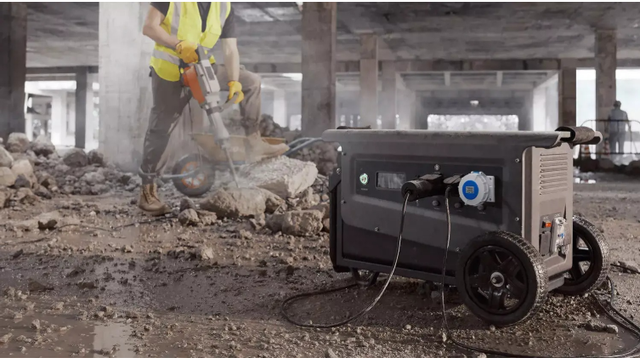
Industrial grade battery power systems handle this through inverter designs that are built to deliver surge capacity substantially above their continuous rated output. SOUOP’s industrial range delivers this surge headroom as a standard specification rather than an afterthought, which is what separates equipment rated for genuine industrial use from consumer grade systems that share the same basic technology but cannot perform reliably under real construction loads.
Welding Equipment and Precision Power
Welding is one of the most power demanding and power sensitive operations on any job site. MIG welders, TIG welders, and stick welders all draw significant current, and the quality of the power supply has a direct effect on weld quality. Voltage fluctuations during a weld pass affect arc stability, which affects penetration, bead profile, and the structural integrity of the finished joint.
Running welding equipment from a fuel generator introduces variability in output voltage that experienced welders learn to work around but that cannot be fully compensated for. Battery based industrial power systems with pure sine wave inverters deliver consistent output voltage across the full duration of a weld pass without the frequency variations that generator output carries. For structural welding applications where weld quality is a safety matter rather than just an aesthetic one, the difference in output quality is not a marginal improvement. It is a material one.
Hydraulic Equipment and Pump Systems
Hydraulic power packs, dewatering pumps, and hydraulic compactors represent a category of job site equipment that contractors frequently underestimate when calculating power requirements. These systems run electric motors that drive hydraulic pumps, and those motors are among the most demanding loads on any job site power source.
A mid-size hydraulic power pack may run continuously at 3,000 to 4,000 watts for hours at a time, rather than the intermittent duty cycle of tools that are picked up, used, and set down. Continuous loads are harder on a power system than intermittent ones because there is no recovery period during which the battery can redistribute thermal load. Systems that are undersized for continuous duty will throttle output or shut down under sustained load even if they can handle the same wattage on paper during brief operation.
An Industrial Power Station specified for high demand job site equipment needs to be evaluated against continuous duty ratings, not just peak output figures. This distinction matters more for hydraulic and pump equipment than for almost any other category of job site tool.
Communication and Control Systems
Modern job sites run on more than heavy equipment. Project management technology, site communication systems, CCTV monitoring, electronic access control, and digital survey equipment all require power, and all of them require clean, stable power that does not introduce interference or voltage spikes that damage sensitive electronics.
These systems frequently need to run continuously across the full working day and in some cases through the night, making them a background load that sits alongside the heavy tool loads rather than replacing them. A properly specified industrial power system handles this mixed load profile without difficulty, delivering the clean output that electronic systems require alongside the robust capacity that heavy tools demand.
Contractors who have moved to battery industrial power systems consistently note that the elimination of generator interference has improved the reliability of site communication systems and eliminated a category of electronic equipment damage that they had previously absorbed as a normal cost of operation.
Compressors and Pneumatic Tool Systems
Pneumatic tools are a fixture on job sites where volume and speed of operation matter. Framing crews, concrete finishing crews, and roofing crews all depend on compressors to run nail guns, impact wrenches, and finishing tools at the rate that production targets require. A compressor that cannot maintain pressure because the power supply cannot sustain the motor load slows the entire crew, not just the operator running the compressor.
Battery industrial power systems sized correctly for the compressor being run deliver the consistent motor support that maintains tank pressure across a full working day. The key specification to check is whether the system can sustain the compressor’s running wattage as a continuous load rather than only handling it in short bursts.
Job site equipment is more capable than it has ever been. The power systems supporting it need to match that capability without introducing the limitations that traditional approaches have always carried. That is the standard that modern industrial battery power is being held to, and on the sites where it is being deployed correctly, it is meeting it.